
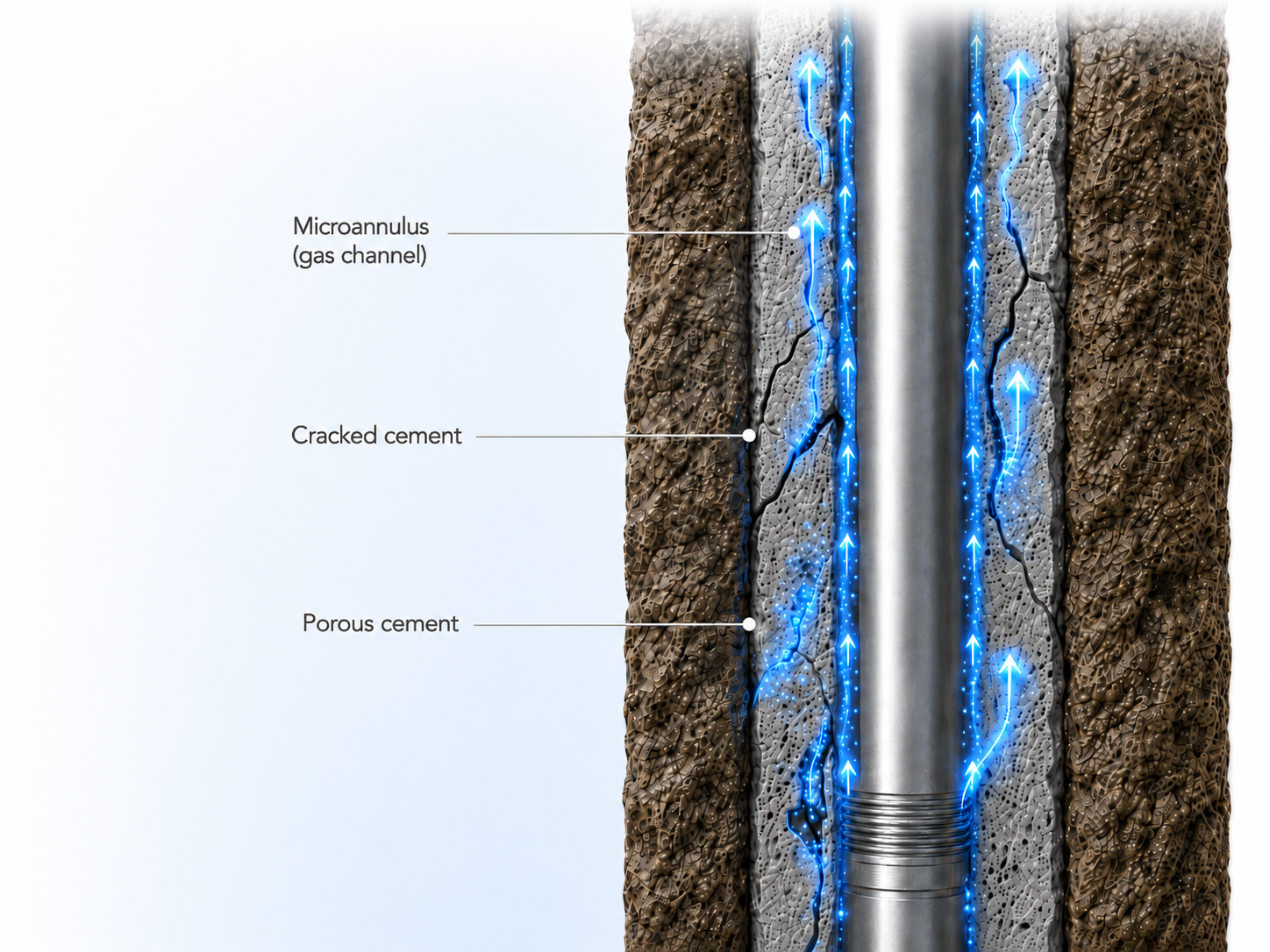
When Conventional Cement Is Not Enough
Gas migration, sustained casing pressure, and annular leakage can persist when conventional cement shrinks, cracks, loses bond, or cannot penetrate small flow paths.
Repeat remediation adds cost, extends timelines, and can delay well completion or abandonment.
TS-Nano provides two practical approaches: improve the cement barrier during placement or deploy a low-viscosity standalone sealant where cement cannot effectively enter.
Multiple Wellbore Applications.
TS-Nano purposefully disperses selected nanoparticles into polymer systems to improve sealing performance, gas resistance, mechanical properties, and bonding to casing, cement, and formation surfaces.
The formulations can be engineered for different cement systems, downhole temperatures, placement methods, and operational requirements.

TSN-23
Cement Modifier
Nano-modified polymer technology incorporated into conventional cement systems to improve resistance to gas migration, shrinkage, cracking, and debonding.
TSN-23 can simplify cement formulations while improving transition behaviour, bond strength, elasticity, and long-term barrier performance.
Applications: Primary cementing, remedial cement squeezes, permanent plugging, and abandonment.

TSN-20
Well Top Sealant
An ultra-low viscosity (8 cPs), nano-modified polymer sealant designed for injection from the wellhead into annular spaces containing cured cement.
TSN-20 penetrates cement porosity and microcracks to form a durable, impermeable barrier, even under low-temperature conditions.
Applications: Near-surface annuli, conductor and surface-casing leakage, and other shallow wellbore integrity challenges.

TSN-25
Standalone Sealant
A low-viscosity nano-modified polymer sealant engineered to penetrate microcracks and low-injectivity flow paths that cement will not reach.
TSN-25 is denser than fresh water, does not dilute in water, and can be deployed riglessly for targeted wellbore remediation across a wide range of temperatures.
Applications: Difficult low-rate injection conditions, surface casing vent flow, annular gas migration, and micro-annuli.


Operators and Industry Partners








What are you waiting for?